How to measure scope 3 emissions
Read time: 7 minutes
Read time: 7 minutes
Learn how to measure Scope 3 emissions across your supply chain. Discover practical ways to engage suppliers, collect carbon data and improve emissions reporting for net zero goals.
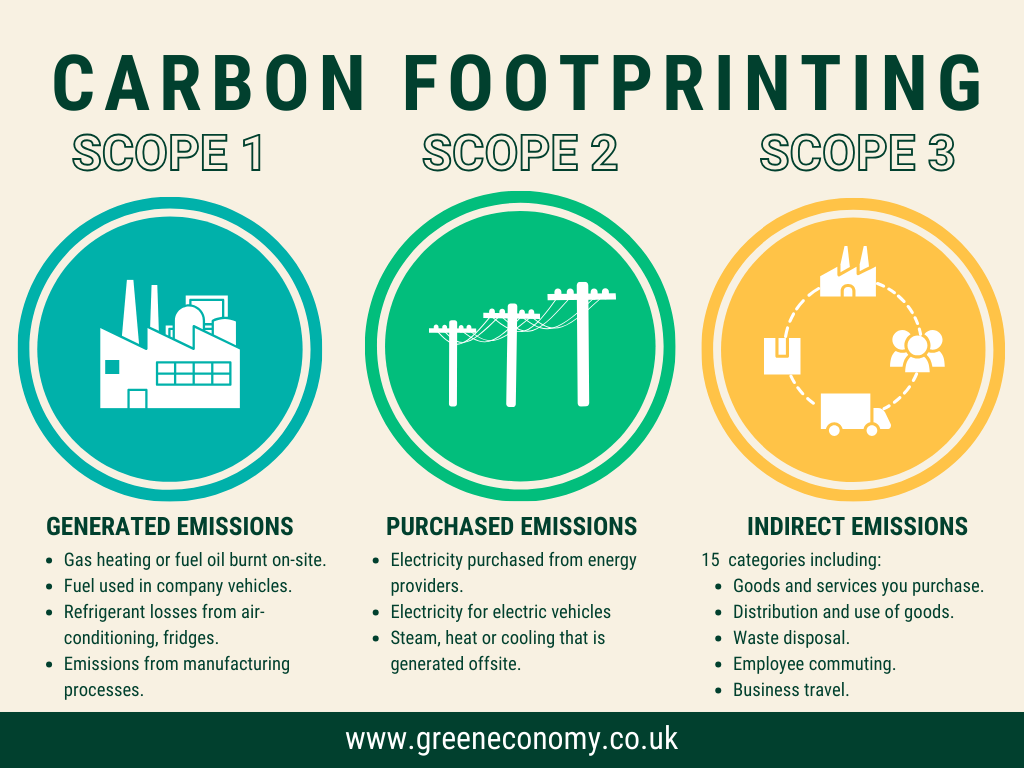
In this guide we're looking specifically at scope 3 emissions, but as a reminder - an organisation’s total carbon footprint can be split into three scopes:
For more information on measuring Scope 1 and 2, take a look at our guide to carbon footprinting.
Things get more complex when it comes to Scope 3, as the diagram below shows, as it accounts for your full value chain.
A manufacturing firm, for example, would include the entire lifecycle of the product – from the extraction, production, and transportation of raw materials to the finished product’s transportation to the customer, its use, and its disposal.
For other sectors, this will require analysis up and down your supply chain – upstream – the products and services that you buy, and downstream – the products and services that you sell and their onward lifecycle. It also includes other indirect emissions you’re responsible for, such as business travel and commuting.
Put simply, your Scope 3 emissions consist of the Scope 1 and 2 emissions of all the other organisations and individuals in your wider value chain.

Understandably, many Scope 3 sources are difficult to identify, let alone measure, especially for smaller businesses. So why attempt to measure your Scope 3 at all?
For starters, those emissions stack up. It’s likely that your total Scope 3 footprint is actually larger than your Scope 1 and 2 footprints combined.
Manufacturers generate a lot of indirect emissions from the raw materials they use and the lifecycle of their products, while office-based businesses tend to have high emissions from business travel and commuting relative to their own operations.
With that in mind, Scope 3 is big focus point for large businesses that are under the most pressure to reduce their impact on the climate. For many companies, Scope 1 and 2 alone are no longer enough to satisfy stakeholders. Under the UN definition, a net zero target must cover Scope 3 emissions “where material to total emissions and where data availability allows”.
In addition, the more you know about your Scope 3 emissions, the better your understanding of your upstream and downstream activities. For example, it may help you identify and manage an unseen risk in your supply chain or reveal that your waste generation is actually a much bigger priority than you may have thought.
In total, there are 15 (8 upstream and 7 downstream) Scope 3 emissions sources laid out under the Greenhouse Gas Protocol, the internationally recognised standard for carbon footprinting. These include:
Some these categories will be more relevant to your business than others, but even so, it’s still quite a lot to take in. The good news is you don’t need to take on all of Scope 3 at once - that’s a difficult piece of work for even the largest of organisations.
Explore our carbon calculator to get an accurate picture of your businesses emissions.
Our team can help you get started or manage the full process.

Some examples of core Scope 3 sources that can be measured (or at least approximated) relatively easily in-house are as follows:
While far from exhaustive, calculating the above is a great start to understanding your Scope 3 emissions. Business travel is often the key category that is mandatory for many standards and formal commitments. The UK’s SME Climate Commitment, which allows SMEs to become signatories to the globally recognised UN Race to Zero initiative, requires that you measure your Scope 1 and 2 emissions plus the business travel element of Scope 3 as a minimum.
Understanding the environmental impact of your suppliers is essential if you want a complete picture of your organisation's emissions and a credible pathway towards net zero. The challenge is that much of this information sits outside your direct control.
The good news is that measuring supply chain emissions does not require perfect data from every supplier from day one. Instead, businesses should take a phased approach, starting with the suppliers, products and services most likely to contribute significantly to their carbon footprint.
Begin by reviewing your procurement spend and identifying suppliers that are likely to have the greatest carbon impact. For many organisations, this could include manufacturers, logistics providers, construction contractors, technology suppliers or providers of energy-intensive products and services.
Focusing on your highest-impact suppliers first will help you gather the most valuable data while keeping the process manageable.
Many suppliers, particularly SMEs, may not yet be measuring their carbon emissions. Rather than treating data collection as a compliance exercise, explain why the information is important and how it will help both organisations understand and reduce environmental impacts.
Be clear about:
Before asking suppliers to undertake complex calculations, find out what information they already have available. This may include:
Many larger suppliers will already be reporting emissions and may be able to provide information quickly.
If suppliers are at an earlier stage of their sustainability journey, keep requests proportionate. Simple questionnaires or supplier surveys can help gather key information without creating unnecessary administrative burdens.
You could ask suppliers:
Over time, you can build on this information and move towards more detailed carbon reporting.
To improve the quality and consistency of Scope 3 data, consider embedding sustainability requirements into procurement and supplier management processes.
This could include:
Making carbon reporting part of standard procurement processes helps create a consistent approach across your supply chain.
Remember that many suppliers may be at the beginning of their carbon reduction journey. Providing access to guidance, tools and support can help improve engagement and data quality over time.
Ultimately, collecting Scope 3 data should not be viewed as a one-off exercise. Regular engagement with suppliers can improve transparency, identify opportunities to reduce emissions across the value chain, and help both organisations make progress towards their sustainability goals.
While Scope 3 emissions can be challenging to measure, businesses do not need perfect data to get started. By prioritising key suppliers, requesting existing information and building carbon reporting into supplier relationships, organisations can develop a clearer understanding of their supply chain emissions and take meaningful steps towards reducing their overall carbon footprint.
The carbon footprints reported by most SMEs will typically cover Scopes 1 and 2. This is because these are the emissions you have the most control over, and they can generally be calculated using easily obtainable data.
As a business measuring your carbon footprint for the first time, Scopes 1 and 2 will provide a good overview of your direct climate impact, however, to have a fuller picture and to respond to demands from your customers or investors, Scope 3 is required.
SMEs can generally focus on a smaller subset of Scope 3 categories tailored to the data they have available and/or the activities that represent the most significant or controllable proportion of their emissions.

We are a social enterprise building a more sustainable economy, powered by local suppliers. We help organisations leverage sustainability to grow, while helping green tech and environmental services business win new business in their local area.
If you're interested in exploring how we can help your business grow, get in touch and one of our expert advisors will be happy to help.
Get impartial end-to-end support when investing in
renewables and energy efficiency technologies.
Use our free Carbon Calculator to get an accurate picture of
your organisation's carbon footprint.
Search our Marketplace to find a trusted partner
for your green tech investment.
Share
Written by
